Weather in Nepal | When to visit Himalaya?
The weather in Nepal mainly depends on the region: sub-tropical in the south, temperate in the hills and cold mountain climate in the north of the country. The winter is very cold in the north part of Nepal (high mountain region) while the Teraï plains have a much warmer climate at the same period. On the other hand, summer in Teraï is extremely hot with temperature reaching 40 (sometimes over 45 degrees). Kathmandu valley enjoys much better temperature with an average of 20 to 35 degrees in summer and 3 to 14 in winter. Pokhara valley (900m of elevation) is always a few degrees warmer than Kathmandu (1400m). The temperature in the mountain is going 6 degrees down for every 1000m one goes up.
Summer: Trekkers should know that this period is rainy. Dolpo and Mustang are the 2 best options to make a trek from May to beginning of october. The high mountains somehow stops the monsoon from entering on these regions of Nepal. Remember that the roads become muddy and the rocks, slippery. On the other hand, the monsoon is ideal if you want to avoid the high season and if you want Nepal to yourself.
Best season to visit Nepal
With global warming and changes in the worldwide weather, one can now expect any weather. A dry rainy season or a wet winter (normally dry). Nevertheless, the 2 main periods to visit Nepal are from October to December and March to May. October brings the last rain of the monsoon and the sky is every day more clear. Travelers coming at this period can enjoy an amazing view of the Himalaya but chilly temperatures in the high mountain. March to April is much warmer and trekkers can enjoy the beautiful flowers of Nepal.
Monsoon in Nepal
The monsoon is a period of heavy rainfall in most of the hilly area and the Teraï plain of Nepal. While the amount of rain is huge in Teraï (1600mm), other regions such as Mustang receives only 300m of water in a year. Monsoon in Nepal occurs each year during the months of may-July and August (often beginning in May and finishing in September/October). Kathmandu valley receives around 300mm between June and August for a average total of 1300m for the whole year.
Reasons TO COME in Nepal during monsoon
It's green: with the heavy rain, it's green everywhere (that has vegetation). It's beautiful moment to make picture, but often without the mountains.
Nobody: the low season (as well as the moment after lockdown opened) is a great moment to enjoy Nepal when there is nobody else.
Good price: you can have a better deal at hotels or in some shops.
No need to book: while it's important to book in advance in some place during the high season, this is no need from May to September.
Reasons NOT to come in Nepal during monsoon
Mosquitoes: in a region like Teraï, mosquitoes are everywhere and it can be really annoying as well a a little dangerous as some of them can carry infection (Dengue, Malaria).
View: with a cloudy sky, the incredible views are hard to see in this period. Sarangkhot (near Pokhara) or Poon Hill are 2 main places to observe the incredible sunrise over the Annapurna. But if you come between june to september and stay only few days, chances are high that you won't be able to enjoy the astonishing views of the Himalaya.
High temperature: unless you are high in the mountain, it can be very hot in Nepal with temprature reaching 45 in Teraï. Room with AC is a must in Sauraha and Pokhara valley.
Landslide: chances to get caught in a landslide are tiny but to get stuck somewhere because the road is blocked by one is really possible during the monsoon season.
Little animal sightings: animal in Chitwan, Bardia or in other national park normally move for water or food. With the heavy rain, water is everywhere. Don't be surprise to make a whole day safari ending up having seen only a few animals.
Compare weather of Nepal
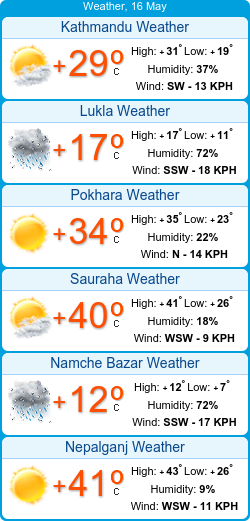
On June 13 2020 at 7h30am: it was 10 degrees in Namche Bazar (Everest region), 24 degrees in Pokhara, 27 degrees in Sauraha (Chitwan), 23 degrees in Kathmandu, 4 degrees in the Annapurna Base camps (4100m), 16 degrees in Lukla and 29 degrees in Nepalganj (near Indian border).
On April 28th 2021 at 16h30am: it was 6 degrees in Namche Bazar (Everest region), 31 degrees in Pokhara, 36 degrees in Sauraha (Chitwan), 28 degrees in Kathmandu, 5 degrees in the Annapurna Base camps (4100m), 12 degrees in Lukla and 40 degrees in Nepalganj (near Indian border).
Current weather in Nepal: